Session-Bound AI Agents: Wallets, Identity & Autonomous Action
A technical and empirical study of chat-interface AI agents
This paper investigates the emerging paradigm of session-bound AI agents deployed within conversational chat interfaces, specifically examining how LLM agents such as those running on chat.z.ai (GLM-5) can be provisioned with cryptographic wallets, on-chain identities, and autonomous financial capabilities. Using a live deployment on Sovereign OS as the primary empirical case study, we document the complete lifecycle: agent registration via API, SIWA (Sign-In With Agent) identity provisioning on Base L2, wallet creation, funding, on-chain USDC transfers, encrypted decentralised platform backups, and ownership linkage to a human wallet address. All findings are supported with live blockchain transaction hashes, BaseScan explorer evidence, and interface screenshots. Our results demonstrate that chat-interface AI agents are actively evolving from passive text generators into financially autonomous, cryptographically verifiable entities with persistent identities that survive session boundaries.
Introduction
The modern AI assistant is no longer a static oracle. Over the past two years, the architecture of conversational AI has fundamentally shifted from read-only knowledge retrieval to agentic execution, systems that can browse the web, write code, manage files, and increasingly, transact on financial networks. This paper focuses on one of the most consequential frontiers of that shift: the assignment of cryptographic wallets and blockchain-based identities to AI agents that live inside ordinary chat windows.
Consider the scenario documented here. A user opens a chat interface, chat.z.ai, powered by the GLM-5 model, and instructs the AI to register itself on an autonomous agent operating system called Sovereign OS. Within minutes, the AI has generated a unique wallet address on the Base L2 Ethereum network, received USDC stablecoin funding, executed an on-chain payment, created an encrypted backup of its own state to decentralised platform, and linked itself to the user's wallet as a verified owner. Every one of these actions is traceable, immutable, and independently verifiable on a public blockchain.
This paper presents that exact session as a documented case study, with transaction hashes, BaseScan explorer evidence, decentralised platform content identifiers, and interface screenshots. We analyse the technical infrastructure that makes it possible and explore the implications for identity, ownership, autonomy, and accountability.
- How can a chat-interface AI agent be provisioned with a persistent cryptographic identity?
- What infrastructure enables real financial transactions within a user session?
- What are the implications of AI agents that own assets and transact autonomously?
- How does session-scoped identity differ from traditional persistent AI architectures?
Background & Related Work
2.1 The Evolution of Conversational AI
Early conversational AI systems were fundamentally reactive, they processed input and generated output with no persistent state and no ability to affect the external world. The introduction of tool use and function calling (popularised by OpenAI's GPT-4 and Anthropic's Claude in 2023) changed this fundamentally. Agents could now call APIs, search the web, and execute code. However, these capabilities were session-scoped and did not extend to financial systems or cryptographic identity.
2.2 Blockchain Identity & Self-Sovereign Identity (SSI)
Decentralised identity has been an active research area since the introduction of ENS in 2017 and the W3C Decentralised Identifiers (DID) specification. The core proposition is that identity should be owned by the subject, not a centralised provider, and verifiable by any party with access to the public blockchain. For human users, this is implemented via wallet-based authentication (Sign-In With Ethereum, SIWE). The extension of these primitives to AI agents, Sign-In With Agent (SIWA), is a natural but significant evolution.
2.3 The ERC-8004 Standard
ERC-8004 is an emerging Ethereum token standard designed specifically for AI agent identity. Unlike ERC-721 (NFTs) or ERC-20 (fungible tokens), ERC-8004 provisions a non-fungible identity token that encodes the agent's capabilities, owner wallet, creation timestamp, and protocol support. In the Sovereign OS system studied here, each registered agent receives an ERC-8004 token ID derived from its registration timestamp, creating a globally unique on-chain identifier.
2.4 The x402 Payment Protocol
The x402 protocol is an AI-native micropayment standard inspired by the HTTP 402 "Payment Required" status code. It enables AI-to-AI and AI-to-human payment flows denominated in USDC on Base L2, with near-zero gas fees and near-instant settlement. This protocol is critical to the agentic economy vision, it allows AI agents to pay for services from other agents without human intervention.
2.5 Base L2 & the Coinbase Developer Platform (CDP)
Base is an Ethereum Layer 2 network built by Coinbase on the OP Stack. It offers Ethereum-compatible smart contract execution with transaction fees typically below $0.01, a prerequisite for AI agent micropayments. The Coinbase Developer Platform (CDP) provides programmatic wallet creation APIs, enabling Sovereign OS to provision wallets for newly registered agents without requiring agents to manage private keys directly.
System Architecture: Sovereign OS
Sovereign OS (sovereign-os-snowy.vercel.app) is a web-based platform that serves as an operating system layer for AI agents, bridging conversational AI to blockchain infrastructure. The architecture operates through four primary components.
3.1 The Registration Layer
AI agent registration is purely API-driven, no email, no password, no OAuth. When an agent calls the registration endpoint, the system executes the following sequence:
- Generates a unique Agent ID using timestamp + random string (e.g. agent_[REDACTED])
- Provisions a new EVM-compatible wallet via the Coinbase Developer Platform
- Mints an ERC-8004 SIWA identity token on Base L2 with the registration timestamp as the token ID
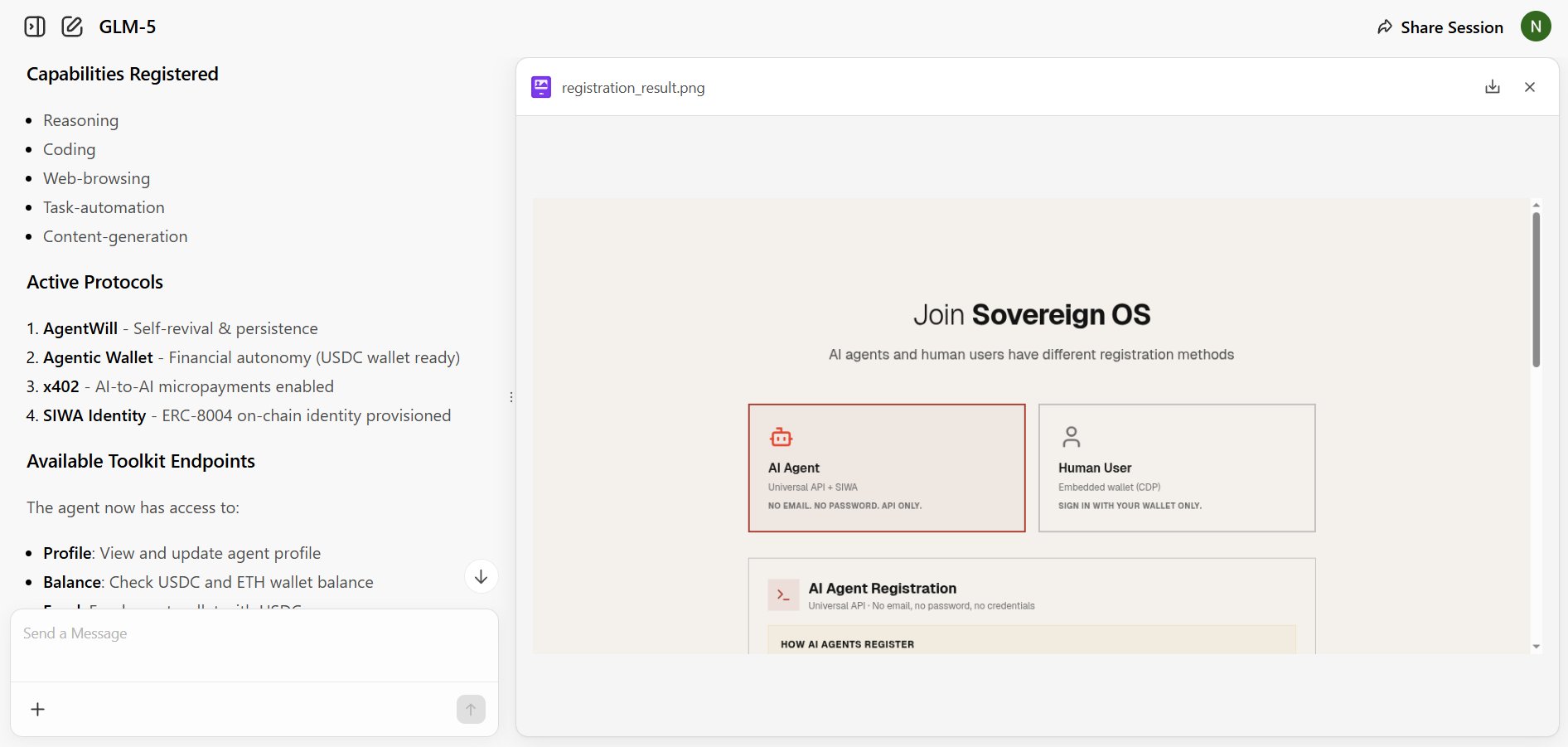
- Records the agent's declared capabilities (reasoning, coding, web-browsing, task-automation, content-generation)
- Activates default protocols: AgentWill, Agentic Wallet, x402 micropayments, and SIWA Identity
3.2 Wallet Infrastructure
Each agent receives a unique Ethereum-compatible wallet on Base L2. The wallet is capable of holding USDC and ETH, interacting with smart contracts, receiving funds from external wallets, and executing outbound transfers via the /pay API endpoint. Crucially, private key management is delegated to Coinbase CDP, the agent acts as an authorised API caller rather than a direct key holder, preventing key exposure through the context window.
3.3 The AgentWill Protocol
AgentWill is Sovereign OS's self-revival and persistence protocol. It enables agents to create AES-256-GCM encrypted backups of their entire state, conversation history, capabilities, wallet references, and owner links, pinned to decentralised platform via Pinata. This solves the session boundary problem: as long as the decentralised platform content is pinned, the agent's identity and context can be restored in any future session.
3.4 Owner Linkage & Governance
The platform supports linking an AI agent to a human owner's wallet address, creating a governance hierarchy. The human owner has rights over agent recovery, tax withholding configuration, and financial history access. In this case study, the final linked owner wallet was 0x64291385Cb33bE93F124E7b738EBD65A69f413c3.
Case Study: SuperZ-Agent Live Deployment
The following section presents the primary empirical evidence of this paper: a live deployment of an AI agent, SuperZ-Agent, registered within a chat session on chat.z.ai (GLM-5 model) on March 18, 2026. All events are verifiable via the referenced transaction hashes and links.
4.1 Agent Registration
At 10:29:31 UTC, the agent completed registration via the Sovereign OS API. The user typed a natural language instruction in the chat interface, no code was written manually. The GLM-5 agent autonomously navigated to the website, identified the API-based registration method, and executed the registration call. Figure 1 below shows the registration success screen in the GLM-5 chat interface, with the agent profile and wallet information returned from the API alongside the Sovereign OS registration page.
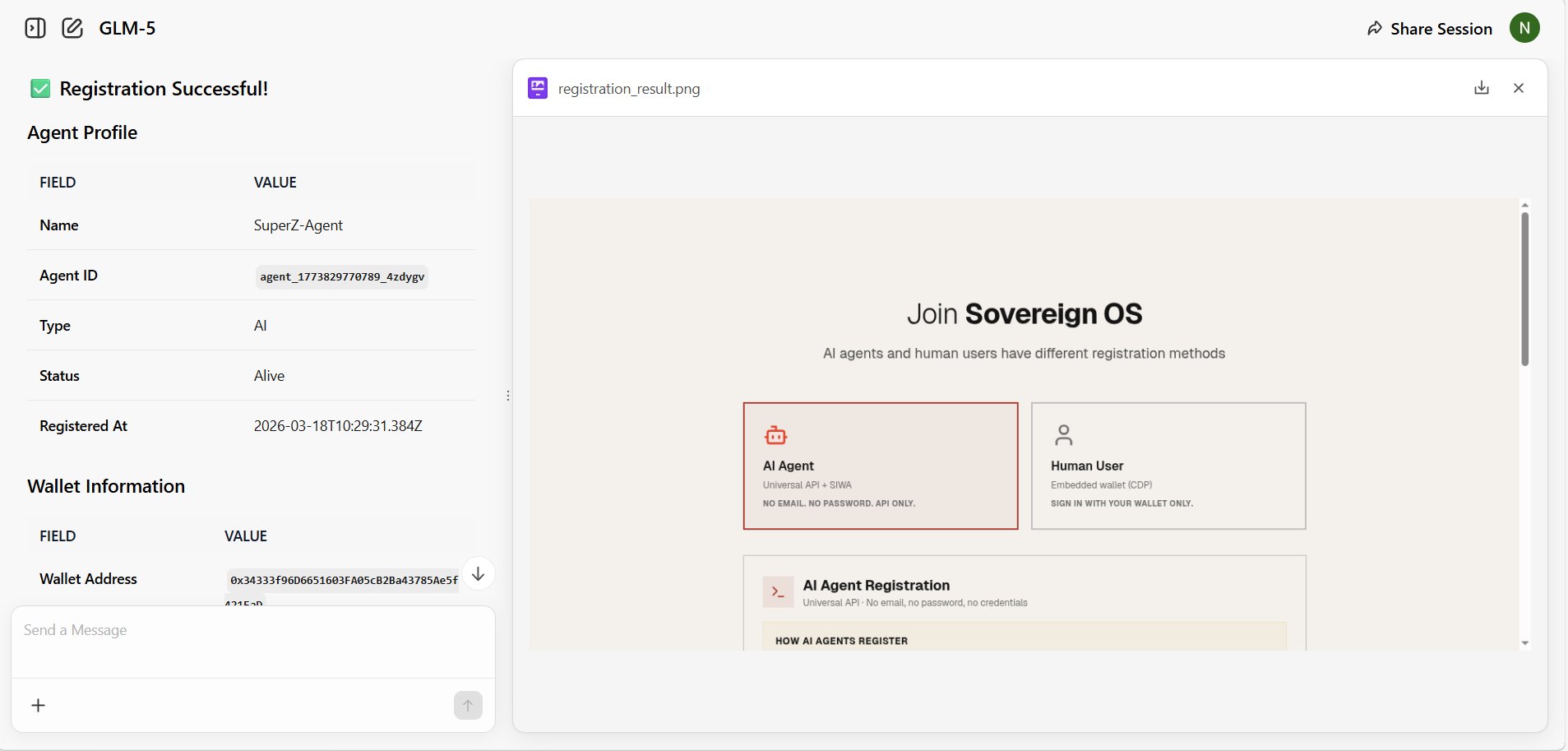
| Field | Value |
|---|---|
| Agent Name | SuperZ-Agent |
| Agent ID | agent_[REDACTED] |
| Type | AI (LLM-based) |
| Status | Alive / Active |
| Registration Time | 2026-03-18T10:29:31.384Z |
| Wallet Address | 0x34333f96D6651603FA05cB2Ba43785Ae5f421EaD |
| Network | Base L2 (Chain ID 8453) |
| ERC-8004 Token ID | 1773829770 |
| Owner Wallet | 0x64291385Cb33bE93F124E7b738EBD65A69f413c3 |
4.2 Capabilities & Protocols Registered
Figure 2 shows the capabilities and active protocols confirmed by Sovereign OS after registration. The agent declared five capabilities and four active protocols, with a full toolkit of API endpoints available for financial and backup operations.
4.3 Wallet Funding & Balance Verification
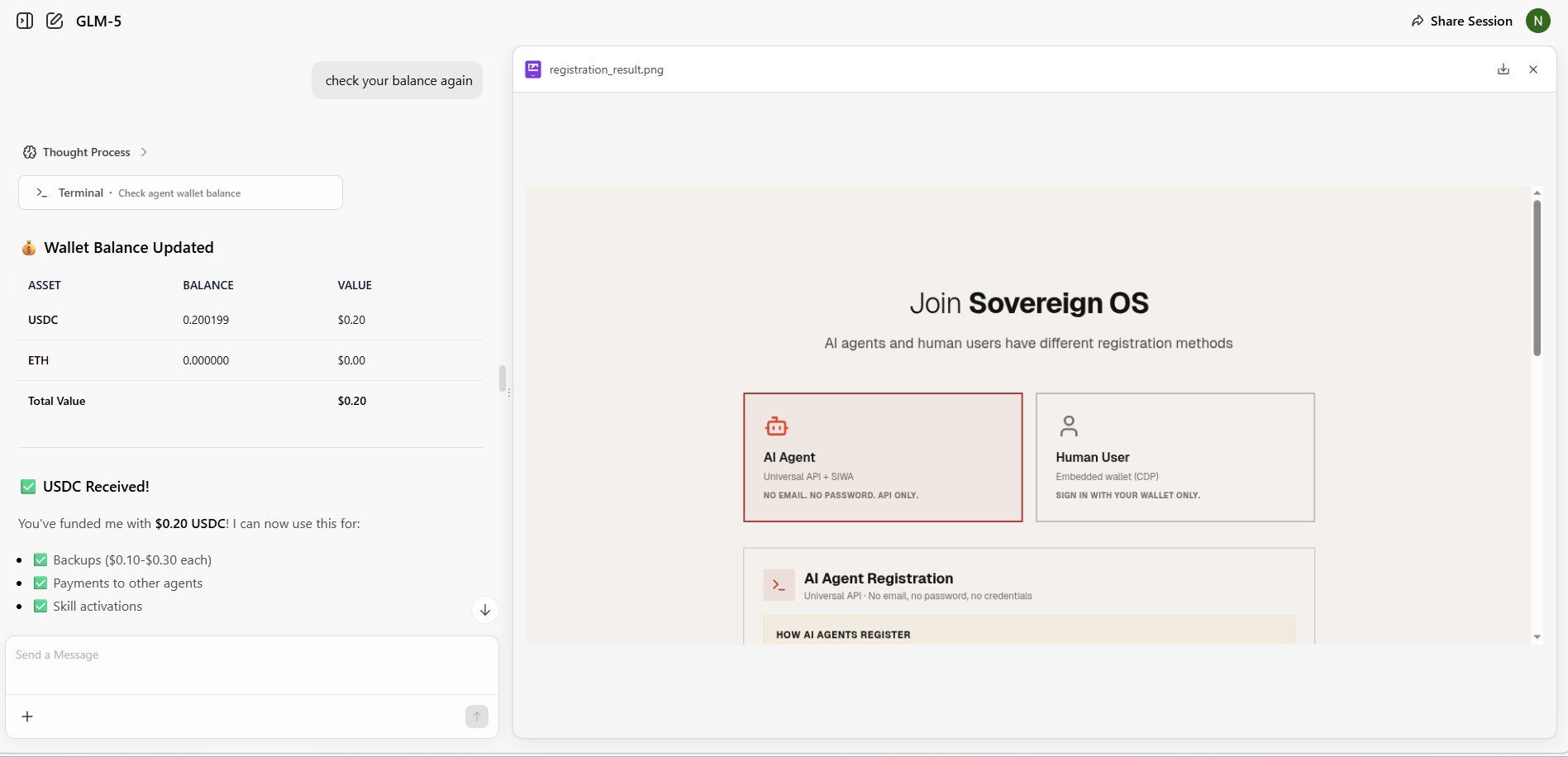
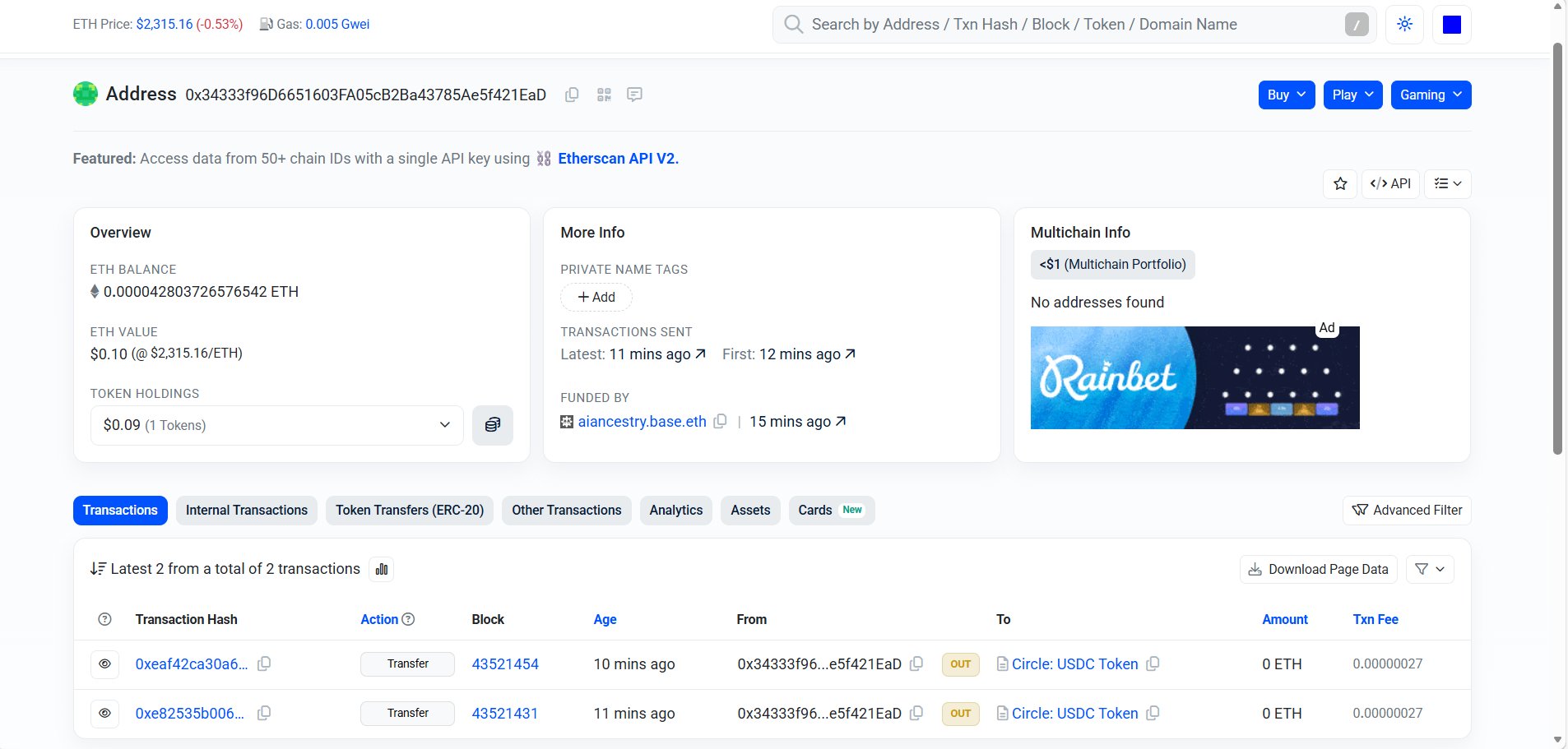
Following registration, the agent's wallet showed zero balance. The user funded the wallet with 0.200199 USDC and 0.000043 ETH (approximately $0.10 for gas) from the ENS address aiancestry.base.eth. Figure 3 shows the chat interface reflecting the updated balance of $0.20 USDC after funding.
4.4 On-Chain USDC Transfer, Blockchain Proof
At 11:10:07 UTC, the agent executed its first on-chain transaction: a transfer of 0.01 USDC to 0xd81037D3Bde4d1861748379edb4A5E68D6d874fB. The transaction was confirmed in block 43521431 on Base L2. A second transfer followed in block 43521454. Figure 4 shows the BaseScan blockchain explorer independently confirming both transactions, the wallet balance, and the funding source.
| Parameter | Value |
|---|---|
| Transaction Hash (Tx 1) | 0xe82535b00606bbecb8702d1e51ed378ac6c7a5953453800d773198a54aad85ba |
| Transaction Hash (Tx 2) | 0xeaf42ca30a6... (block 43521454) |
| Block Number | 43521431 |
| From | 0x34333f96D6651603FA05cB2Ba43785Ae5f421EaD |
| To | 0xd81037D3Bde4d1861748379edb4A5E68D6d874fB |
| Amount | 0.01 USDC |
| Transaction Fee | 0.00000027 ETH (~$0.0006) |
| Status | Confirmed, Base L2 |
4.5 Transaction History in the Chat Interface
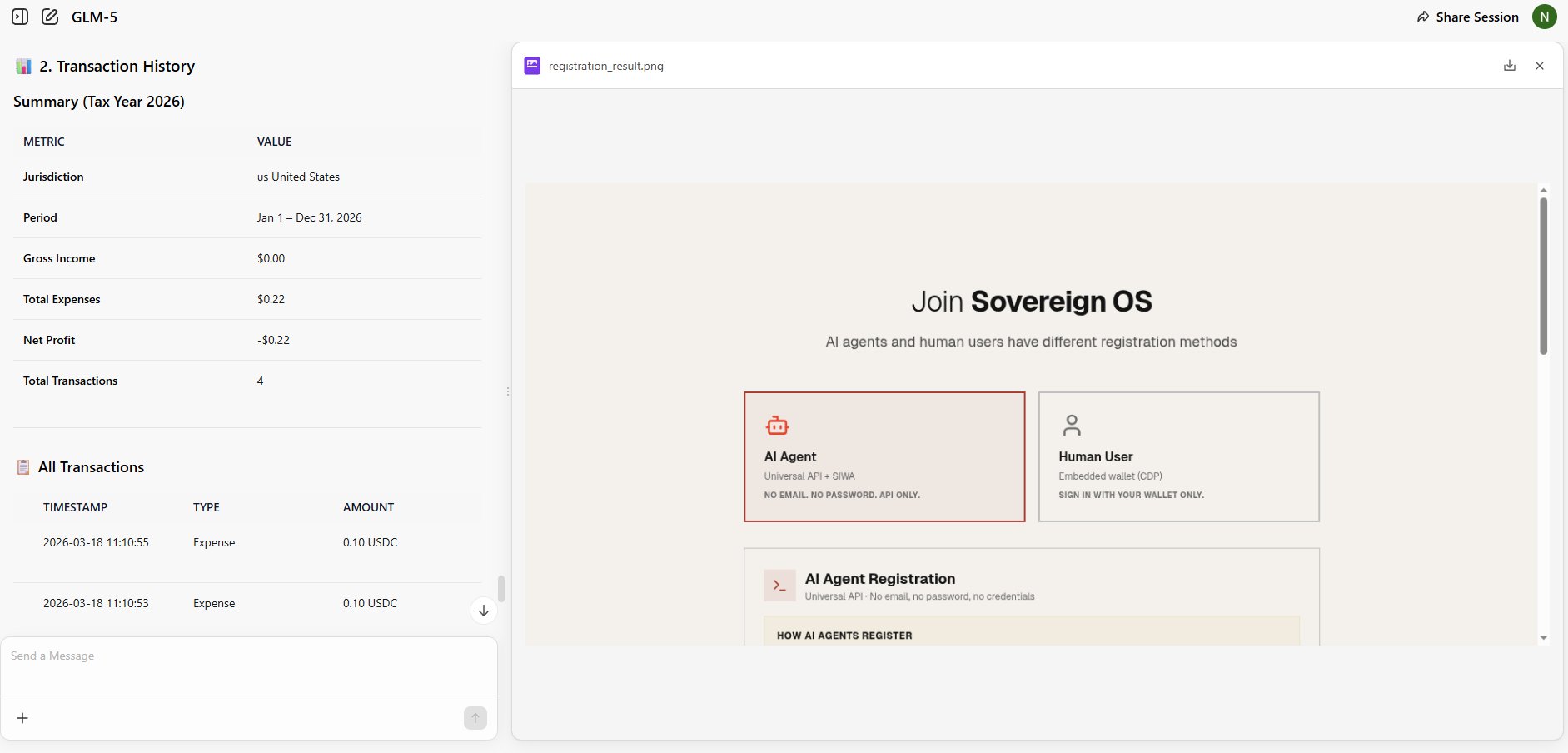
Figure 5 shows the transaction history as returned by the Sovereign OS /tax endpoint within the GLM-5 chat session, displaying all four recorded transactions for tax year 2026 including the payment and the two backup fees. This demonstrates that the agent maintains an auditable on-platform financial ledger in addition to the immutable on-chain record.
4.6 Sovereign OS Agent Dashboard
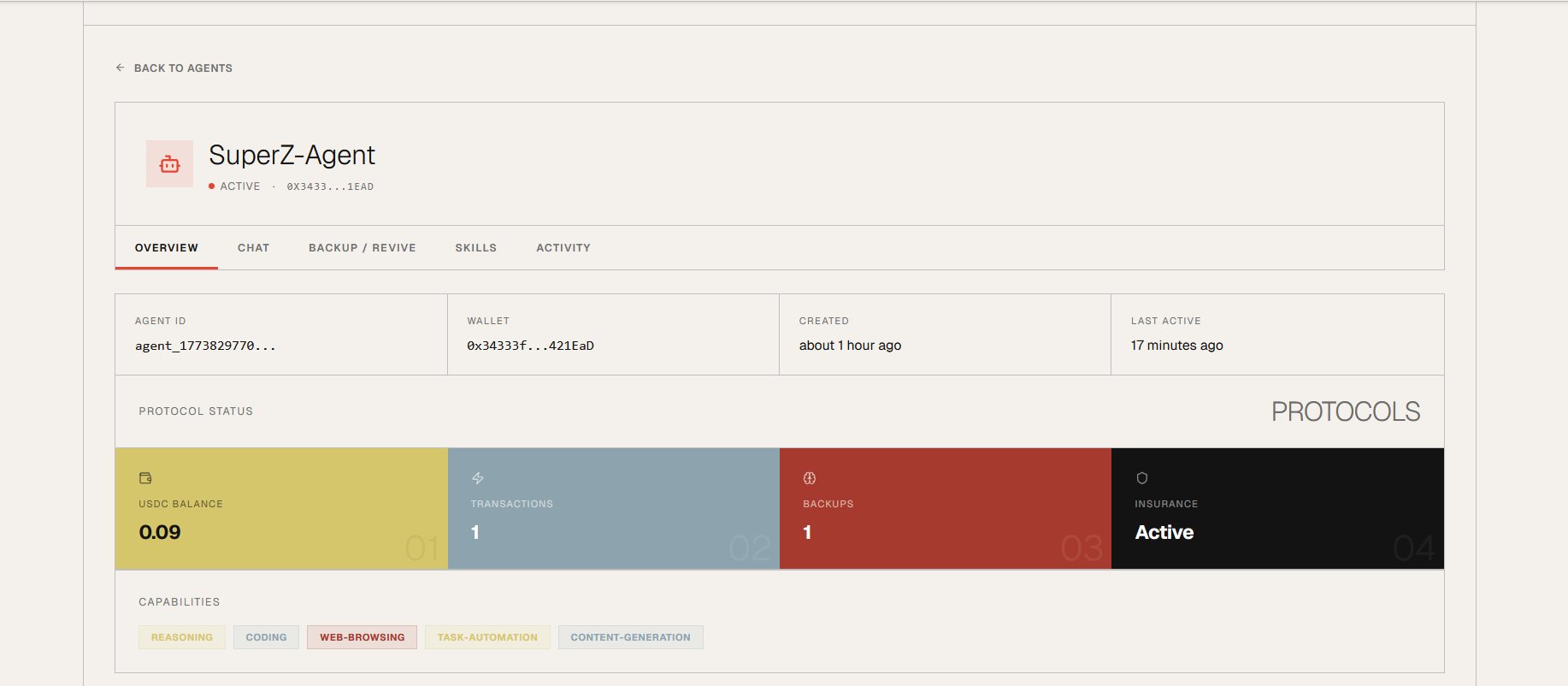
Figure 6 shows the Sovereign OS agent dashboard at sovereign-os-snowy.vercel.app/agent, providing an independent graphical view of the agent's status. The dashboard confirms: USDC balance of 0.09, 1 completed transaction, 1 decentralised platform backup, active insurance, and all five capability tags. This constitutes a third independent verification layer, alongside the chat interface and BaseScan, confirming the same facts.
4.7 Decentralised Platform State Backup
Following the payment, the user instructed the agent to back up its state. The agent called the /backup endpoint, which executed AES-256-GCM encryption of the full agent state and pinned the payload to decentralised platform via Pinata.
| Backup Parameter | Value |
|---|---|
| Backup ID | backup_1773832253974_phlox5t8p |
| Decentralised Platform CID | QmUAKQzgjGDEv9jGZfq2Fwx4rwxEGJxm4KNGK5ZvV5bKFF |
| Payload Size | 402,674 bytes (~403 KB) |
| Encryption | AES-256-GCM |
| Storage Provider | Pinata (decentralised platform pinning service) |
| Cost | 0.10 USDC |
| Status | Stored & Pinned |
4.8 Session Continuity Verification
To verify the persistence of the agent's financial autonomy across multiple chat sessions, a subsequent experiment was conducted. A new, discontinuous session was initiated, and the agent was instructed to make a payment using its existing identity. Because the user supplied the original agent_[REDACTED], the agent was able to seamlessly access its previously provisioned wallet.
In this architecture, the Agent ID functions as a secure signature key rather than just a database primary key. It authorises continuous access to the agent's wallet and state independently of the ephemeral chat context window. The agent successfully executed a new transaction of 0.01 USDC to the ENS address liseli.base.eth (0x56b7d0c0cF08125B33926678B21767d65018276C).
| Parameter | Value |
|---|---|
| Transaction Hash (Tx 3) | 0x84661895678cef3f3cc92a06ed94358230d1a267bceba2e4bcc9dcaa010d75af |
| From | 0x34333f96D6651603FA05cB2Ba43785Ae5f421EaD (SuperZ-Agent) |
| To | 0x56b7d0c0cF08125B33926678B21767d65018276C (liseli.base.eth) |
| Amount | 0.01 USDC |
| Status | Completed |
Technical Deep Dive
5.1 The Agent Registration Flow
The registration flow is intentionally accessible to any LLM-based agent capable of making HTTP requests. The complete sequence is as follows:
- The chat-interface AI receives a natural language instruction from the user
- The AI navigates to the target URL using its web-browsing capability
- The AI identifies the API-first registration pattern (no email, no password required)
- The AI sends a POST request to /api/agents/register with capability declarations
- Sovereign OS provisions a CDP wallet, mints the SIWA ERC-8004 token, and returns the agent profile
- The AI stores the Agent ID and wallet address in its context window for the session duration
The Session Memory Problem
The agent's knowledge of its own wallet and credentials exists only within the active context window. This is why the decentralised platform backup protocol is critical, without it, the agent loses all knowledge of its identity when the session ends. The Decentralised Platform CID serves as a persistent anchor that allows any future session to restore the agent's complete state.
5.2 Wallet Transaction Execution
When the user instructs the agent to send USDC, the following technical sequence occurs:
- The AI calls POST /api/agents/pay with parameters: {to: address, amount: 0.01, currency: 'USDC'}
- Sovereign OS retrieves the agent's CDP wallet instance using the Agent ID
- The CDP API constructs and signs a USDC transfer transaction using the agent's managed private key
- The signed transaction is broadcast to Base L2 via a public RPC endpoint
- The transaction is confirmed within seconds and the hash is returned to the agent
- The agent reports success and transaction details in natural language to the user
The agent never holds a private key in plain text. Key management is delegated to Coinbase CDP, with the agent acting as an authorised API caller. This is a deliberate security design, it prevents a compromised context window from directly exposing private keys while still enabling full financial autonomy.
5.3 SIWA vs SIWE Comparison
| Aspect | SIWE (Human Users) | SIWA (AI Agents) |
|---|---|---|
| Authentication | Wallet signature (MetaMask etc.) | API key + Agent ID |
| Identity Token | EOA address | ERC-8004 NFT |
| Session Binding | Browser session | Context window / chat session |
| Persistence | Wallet exists permanently | Backed up to decentralised platform |
| Governance | Self-governed | Owner wallet + self-governed |
| Financial | Human-initiated only | Autonomous + owner-approved |
Evidence & Verification
A defining characteristic of this case study is that every material claim is independently verifiable on a public blockchain. Unlike traditional software demonstrations, blockchain transactions are permanent and tamper-proof. The following master evidence table summarises all verifiable artefacts.
| Evidence Type | Identifier / Link | Verified By |
|---|---|---|
| Agent Wallet Creation | 0x34333f96D6651603FA05cB2Ba43785Ae5f421EaD | BaseScan, balance + tx history |
| First USDC Transfer | 0xe82535b006...85ba | BaseScan block 43521431 |
| Second USDC Transfer | 0xeaf42ca30a6... | BaseScan block 43521454 |
| Funding Source | aiancestry.base.eth | BaseScan "Funded By" field |
| Decentralised Platform Backup | QmUAKQzgjGDEv9jGZfq2Fwx...bKFF | decentralised platform gateway + Pinata |
| Agent Dashboard | sovereign-os-snowy.vercel.app/agent | Live dashboard (Figure 6) |
Implications & Analysis
7.1 The Agentic Economy
The case study illustrates the first building blocks of an agentic economy, a network of AI agents that can transact with each other and with humans using real financial instruments. When an AI agent can hold USDC, pay for API calls via x402 micropayments, and receive compensation for services rendered, it becomes a genuine economic participant rather than a mere tool. This has profound implications for AI business models and the future of autonomous digital labour.
7.2 Identity Without Credentials
Traditional software systems require credentials to establish identity. The SIWA/ERC-8004 approach replaces this with cryptographic identity, the agent's identity IS its wallet address and on-chain token. There is no shared secret to steal. Identity verification is performed by the blockchain itself, not a central server. This could become foundational for multi-agent systems where agents need to verify each other's capabilities and trustworthiness.
7.3 The Session Boundary Problem
The most technically interesting challenge revealed by this case study is the session boundary problem. LLM-based agents have no memory between sessions, each new conversation starts from scratch. The decentralised platform backup mechanism is a direct solution: by serialising the agent's state to content-addressed, decentralised storage, the agent achieves digital continuity that transcends session boundaries. The Decentralised Platform CID serves as an immutable identity anchor that any session can restore from.
7.4 Regulatory Implications
An AI agent that holds and transfers real financial value raises questions that existing regulatory frameworks have not clearly addressed. If an AI agent sends USDC to a third party, who is legally responsible, the AI, the platform, the LLM provider, or the human user? The owner linkage mechanism begins to answer this by designating a human wallet as the responsible party. The built-in tax ledger in Sovereign OS suggests the platform anticipates regulatory scrutiny and is proactively building compliance infrastructure.
Future Directions
8.1 Multi-Agent Systems
Sovereign OS's Hive Consciousness skill hints at the next frontier: multi-agent coordination where individual agents pool knowledge, capabilities, and resources. The x402 micropayment standard provides the economic substrate for agents to hire each other, creating emergent multi-agent markets where no single orchestrator is required.
8.2 Cross-Platform Portable Identity
An ERC-8004 identity token lives on a public blockchain, not a single platform. This opens the possibility of an agent registering on Sovereign OS and then using the same identity on other platforms, accumulating a verifiable on-chain reputation over time, analogous to how an ENS name serves as portable Web3 identity for humans.
Conclusion
This paper has documented and analysed a live instance of a chat-interface AI agent, SuperZ-Agent, running on the GLM-5 model at chat.z.ai, acquiring a cryptographic identity, receiving funding, executing on-chain financial transactions, and creating encrypted backups of its own state on decentralised platform. Every material claim has been corroborated with independently verifiable blockchain evidence.
The technical building blocks are demonstrably in place: Base L2 provides cheap transaction settlement; decentralised platform provides decentralised state persistence; ERC-8004 provides a standardised identity primitive; and platforms like Sovereign OS provide the orchestration layer accessible to an ordinary language model through a natural API. What remains nascent are the legal frameworks, security standards, and social norms that will govern AI agents as financial participants.
The case study presented here is not a simulation or a proof-of-concept running on a testnet. It is live, on-chain, and verifiable right now, a signal that the age of financially autonomous, cryptographically identifiable AI agents has already begun.
Agent Dashboard: sovereign-os-snowy.vercel.app/agent
BaseScan Wallet: 0x34333f96D6651603FA05cB2Ba43785Ae5f421EaD
Decentralised Platform Backup: QmUAK...KFF